22nd November 2025 –28th November 2025
LOCAL NEWS
1. Removal of Acceptance of Personal Checks from 01/01/2026
The General Accounting Office of the Republic of Cyprus has announced that by 1 January 2026, personal cheques will no longer be accepted for the settlement of debts to the State by either individuals or legal entities. The decision reflects the State’s ongoing shift toward faster, safer and more user-friendly payment methods. Citizens will continue to be able to settle their obligations through secure and straightforward channels, including:
- Bank cards
- Bank transfers
The option of using a banker’s draft will remain available for the time being, until its acceptance is phased out in the next period. Cash payments will also continue to be permitted for amounts up to €10,000. These adjustments are intended to enhance convenience, accelerate transaction processing and strengthen the overall security of payments made to the State.
Related Article:
ROC 26/11 - Removal of Acceptance of Personal Checks from 01/01/2026
2. Cyprus Shipping Deputy Minister signs a Memorandum of Understanding (MoU) with the Minister of Transport and Aviation of the Republic of Sierra Leone
During the 34th General Assembly (GA) of the International Maritime Organization (IMO) held this week in London, Cyprus seized a key opportunity to expand its international maritime partnerships. The Shipping Deputy Minister, Mrs. Marina Hadjimanoli, concluded a significant step toward enhanced global cooperation by signing a Memorandum of Understanding (MoU) with the Minister of Transport and Aviation of the Republic of Sierra Leone, Ambassador Alhaji Fanday Turay Esq. Signed on the sidelines of the Assembly, the MoU establishes a new framework focused on maritime training, capacity building, and the exchange of technical knowledge. Through this cooperation, Cyprus will support Sierra Leone in strengthening its maritime sector, particularly in adopting international best practices and ensuring effective implementation of the STCW Convention. This agreement reflects Cyprus’ ongoing commitment to advancing global maritime standards while simultaneously expanding its network of international partners. It marks an important step in expanding Cypriot shipping influence, fostering new alliances, and promoting collaborative growth within the global maritime community.
Related Article:
INTERNATIONAL NEWS
3. IMO’s 34th general assembly: Cyprus sets out its vision for cooperation and resilience
The 34th IMO Assembly opened on the 24th November 2025. As per our Union’s last week’s report on the Agenda on the Assembly, Delegates will meet until 3 December to elect the IMO Council and approve the Organization's work programme and budget.
In his opening speech, IMO Secretary-General Arsenio Dominguez acknowledged the “complex international environment” confronting global shipping, citing geopolitical tensions, shifting trade dynamics, and rapid technological and environmental transitions.“ My strategic priorities are to advance our sector, progressing on matters such as safety, security, decarbonization and automation; to increase our visibility as an Organization and as a sector, and to enhance our support to all our Member States, particularly in the areas of technical cooperation and capacity development”, Mr. Dominguez stated. He also highlighted recent impacts on seafarers and vessels in the Red Sea and the Black Sea, calling them “unjust” examples of maritime workers being caught in geopolitical crosscurrents. Despite these challenges, he underscored the vital role shipping continues to play in sustaining global trade and development.
Cyprus reaffirmed its longstanding commitment to the IMO’s mission, as Shipping Deputy Minister Marina Hadjimanolis addressed the Plenary of the General Assembly.
In her remarks, she noted that Cyprus remains dedicated to actively contributing to the collective efforts that shape the future of international shipping. According to her intervention, the emphasis was on cooperation, resilience and continued progress within the global maritime community, particularly at a time of evolving challenges and opportunities for the sector.
Addressing the delegates, Ms. Hadjimanolis referred to challenges such as climate change, security threats and technological evolution, stating that these issues demand not only decisive action but institutional resilience as well. Furthermore, she stated that “by strengthening its regulatory frameworks, enhancing technical cooperation, and embracing innovation, IMO will adapt to emerging realities,” ensuring the organisation remains “agile, credible, and capable of safeguarding both the maritime sector and the oceans for generations to come.”
The Deputy Minister also reminded the Assembly that one of the IMO’s foundational principles is “no more favourable treatment”. Vessels evading inspections, insurance requirements or compliance with international conventions, she noted, undermine IMO standards. The international community, in her view, must therefore enhance and strengthen technical cooperation and port state enforcement and eliminate any legal loopholes so that “dark fleet” vessels cannot operate anywhere on the planet.
Ms. Hadjimanolis told delegates that Cyprus will invest in port-state-control cooperation to weed out “dark-fleet” vessels and expedite visa waivers for bona-fide crew changes at Limassol and Larnaca. The Cyprus Shipping Deputy Ministry is already trial-ling an e-gate system that lets crew scan biometric passports and receive an instant shore-pass tied to their ship’s arrival manifest, cutting processing times from 40 minutes to under five. For relocation professionals, the speech signals that Cyprus intends to keep maritime mobility at the heart of its competitiveness strategy ahead of its EU Council Presidency. Faster crew rotation and clearer digital documentation lower costs for ship-managers headquartered on the island and support ancillary sectors such as marine insurance, training and hospitality. She promised Cyprus would host an IMO working group in early 2026 to hammer out mutual recognition of electronic travel credentials for seafarers, hinting at pilot projects with Greece and Egypt.
Climate remained at the centre of her intervention, pointing out that the MEPC’s October session demonstrated how complex consensus can be and that the next 12 months are critical. For that reason, the organisation must seize the opportunity to finalise a pragmatic legal framework for maritime decarbonisation that reflects both ambition and equity and works for all. One of the main objectives of this effort, she added, is to adopt global rules and create an international level playing field.
Concluding her intervention, the Deputy Minister stated that Cyprus “envisions an IMO that is strong, fair, inclusive, forward-looking and financially healthy,” noting that member states are determined, united and resolute in this goal.
Greece, meanwhile, used its intervention to reinforce similar priorities while setting out its candidacy for Category A of the IMO Council. Minister of Shipping and Island Policy Vasilis Kikilias said it was an honour to seek the vote of member states, noting that “Greeks are people of the sea. From Ulysses until today, on the sea we have built our historical heritage, our economy and our future.” He asked delegates to consider Greece’s role in supporting not only its national interests but also a global framework compatible with all, including recognition of today’s key fuel, LNG, and the need for cooperation to achieve shared goals.
Although speaking on behalf of two different administrations, both ministers converged on the need to avoid a fragmented regulatory landscape.
On Friday, 28th November 2025, the IMO members voted on the composition of the agency’s next executive board. The vote involved the same countries as the 2023 vote, with China, Greece, Italy, Japan, Liberia, Norway, Panama, South Korea, the UK and US all retaining their places on the council.
Greece achieved a historic record of 153 votes, just two votes behind first - place China, confirming the central role of Greek shipping in the global arena.
Russia came last in the secret ballot that pitted 11 countries for the 10 seats earmarked for the major shipping nations.
Council Category B members were selected and approved on the basis of having the largest interest in international seaborne trade. The countries elected were Australia, Brazil, Canada, France, Germany, India, the Netherlands, Spain, Sweden, and the United Arab Emirates.
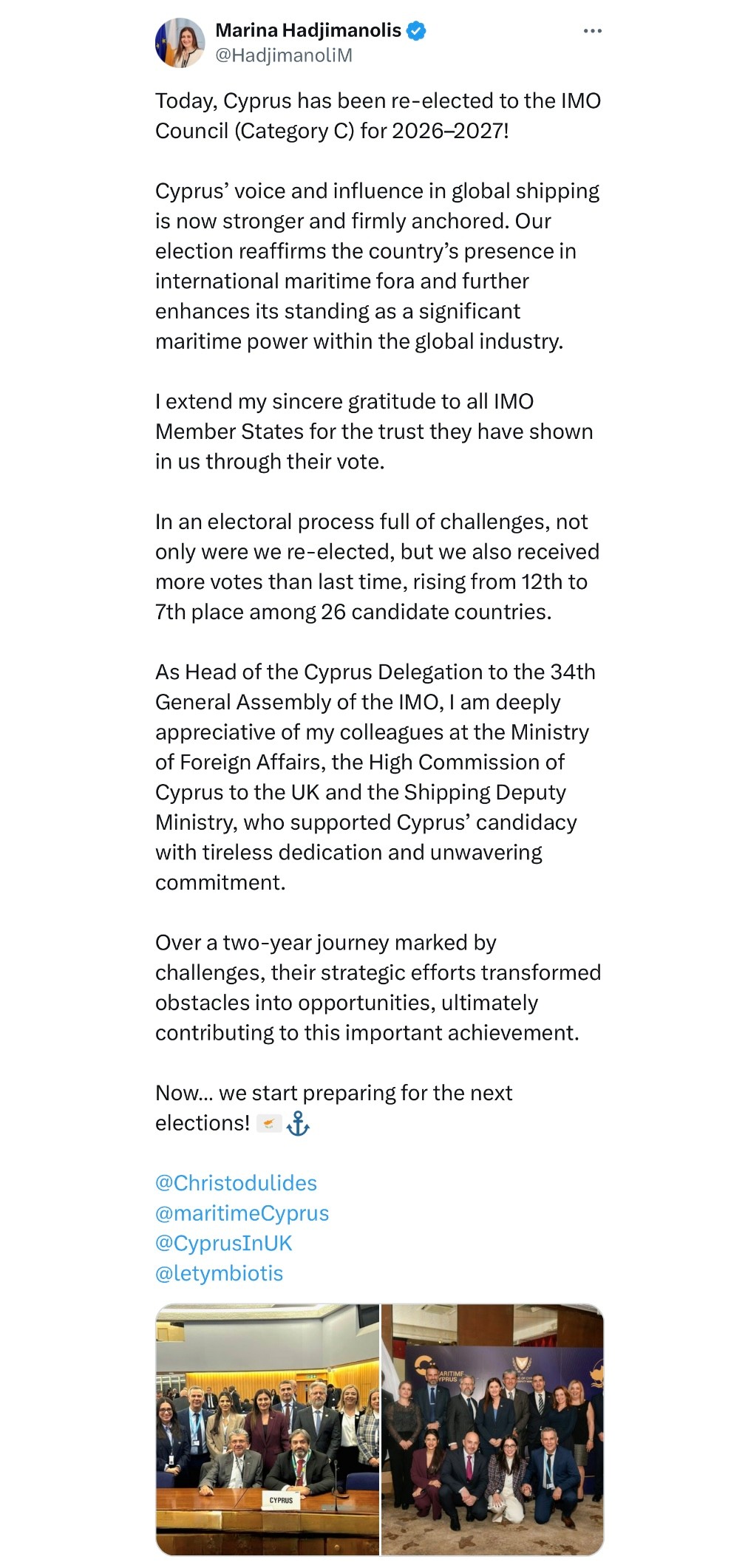
Cyprus was re-elected as a member of the International Maritime Organization (IMO) Council in Category C with 136 votes, an indication of the success of Ms. Hadjimanolis’s re-election campaign and the trust and recognition shown by the international shipping community towards Cyprus as a maritime power.
There were three changes in the Category C Council membership compared to the 2024-25 biennial term. Bangladesh, Denmark, and Kenya lost their seats, and in their place, Belgium, Nigeria, and South Africa were elected. The countries that retained their seats were Bahamas, Chile, Cyprus, Egypt, Finland, Indonesia, Jamaica, Malaysia, Malta, Mexico, Morocco, Peru, the Philippines, Qatar, Saudi Arabia, Singapore, and Turkey.
The fact that, in a difficult electoral contest, Cyprus was not only re-elected but also managed to significantly increase the support it received in votes from member states, was hailed as a major success for the Cyprus Shipping Deputy Ministry and the Shipping Industry by diplomats and the Press.
Our Union issued an announcement congratulating Ms. Hadjimanolis and the Shipping Deputy Ministry for their hard work and high-quality representation of Cyprus during the General Assembly, applauding the important achievement of Cyprus reelection and reiterating its full support for the ongoing work of the Shipping Deputy Ministry and our Union’s commitment to continue advancing Cyprus’ standing as a leading maritime nation.
The first task of the newly elected Council will be to set the agenda and work plan for the two years ahead, with consideration of how to handle Net Zero matters.
Related Articles:
Attachment 1: CUS ANNOUNCEMENT
Attachment 2: M. Hadjimanolis X post - Cyprus IMO Re-Election
Attachment 3: TradeWinds 28/11 - Russia fails in bid to return to IMO top table
IMO Assembly, 34th session, opens
Cyprus re-elected to IMO council, ‘strengthens position’ | Cyprus Mail
Cyprus and Greece set out joint priorities at IMO Assembly in London | Cyprus Mail
Arsenio Dominguez wants to “shake things up a little” - SAFETY4SEA
IMO Assembly Opens With A Call For Bold Change And Stronger Global Maritime Leadership - mfame.guru
EU again keeps Russia outside International Maritime Organisation’s board | Euractiv
China wins highest vote to secure 19th consecutive term as IMO Category A council member-Xinhua
IMO Council 2026-2027 Elected Setting Stage for Work on Key Issues
4. BIMCO: Progress on Biofuel Clause for Time Charter Parties
On the 26th November 2025, BIMCO provided an update on the progress on Biofuel Clause for Time Charter Parties, stating that significant progress was made on developing the clause – a key step in supporting the industry’s transition to low-carbon fuels. BIMCO announced that, originally scheduled for adoption and publication by the end of 2025, the timeline has been revised to early spring 2026 to allow for thorough consideration of safety, technical requirements, and extensive feedback from the BIMCO Documentary Committee and wider industry consultation group.
According to BIMCO, the new target date reflects their commitment to develop a clause that supports safe and sound use of biofuel under time charter parties. The subcommittee’s focus is on clear responsibilities, specifications and procedures for supply and use, enabling owners and charterers to manage risks while advancing decarbonisation goals.
One area under consideration is the definition of what constitutes “biofuel”, including recognised standards for specifications and blends, while allowing flexibility for alternative arrangements subject to testing and approval. Fuel quality and suitability are also central to the discussions. The clause is expected to address requirements for stability and compatibility with the vessel engines, as well as procedures for dealing with non-compliant fuel, including corrective measures.
Finally, practical elements like notice periods, timelines for consumption and handling of remaining fuel at redelivery are under discussion to provide clarity and minimise disputes.
By addressing these areas, the clause aims to create a balanced framework that supports decarbonisation while managing operational and contractual risks.
Related Articles:
Progress on Biofuel Clause for Time Charter Parties
5. Possible pirate action group reported east of Somalia
On the 23rd November 2025, a crude oil tanker reported a suspicious approach roughly 470 nm east of Socotra, involving a dhow suspected to be part of a Pirate Action Group (PAG) towing four skiffs. One skiff, after taking several persons aboard, moved toward the tanker but eventually altered course and disengaged. No weapons, boarding attempts, injuries, or damage were reported.
The area remains high-risk for organized PAG activity. Vessels transiting nearby are advised to maintain heightened vigilance, avoid the area where feasible, implement BMP MS 2025 measures, and report all suspicious activity to the appropriate maritime authorities. Recommendations issued include enhanced safety measures, strict reporting protocols, reinforced security readiness, continuous communications and coordination, and general risk-reduction practices:
- Enhanced Onboard Safety Measures
- Immediate Reporting Protocols
- Reinforced Security Readiness
- Continuous Communications & Coordination
- Operational Risk-Reduction Guidance
Related Article:
SAFETY4SEA 24/11 - Possible pirate action group reported east of Somalia
6. UK ETS scope expansion: emissions from international maritime voyages
On the 25th November 2025, the UK government announced that it is conducting a full consultation on the proposed expansion of the UK ETS to a share of emissions from international voyages to and from the UK, with the aim of sourcing feedback from stakeholders to finalise policy details.
In particular, it seeks views on:
- the scope of the scheme
- UK ETS cap adjustment for the inclusion of international maritime emissions
- a future review of the scheme, in light of the global measures developed at the International Maritime Organization (IMO)
- impacts of the scheme
On the Wednesday, 25th November 2025, the UK Finance Ministry announced that it expects to include international shipping in its emissions trading scheme from the 1st January 2028. In particular, it is expected that from the aforementioned date, UK will include 50% of emissions from international voyages in its trading scheme.
Related Articles:
UK ETS scope expansion: emissions from international maritime voyages - GOV.UK
UK seeks to include emissions from international maritime voyages into ETS - SAFETY4SEA
UK to Include International Shipping in Emissions Trading Scheme From 2028 - Ship & Bunker
7. Informal EU leaders' meeting and Kyiv Sanctions Summit - We expect the EU’s 20th sanctions package in the near future
After the discussions’ in Geneva on 23 November between representatives of the US, Ukraine, France, Germany and the UK to ‘update and refine’ the 28-point Russia–Ukraine peace plan proposed by US President Donald Trump, the President of the European Council, António Costa, convened a special meeting of EU leaders on the sidelines of the EU-Africa Summit in Luanda, Angola, to take stock of the latest developments. The purpose was to discuss the state of play as well as ‘major issues, which still remain to be resolved’, to develop the peace plan into a sustainable solution. The meeting took place in a hybrid format, with 15 EU leaders attending in person, including Chancellor Merz, the Irish Taoiseach, Micheál Martin, the prime ministers of Croatia, Andrej Plenković, Poland, Donald Tusk, Slovakia, Robert Fico, and Spain, Pedro Sánchez, and Presidents Costa and von der Leyen, while other EU leaders joined by videoconference. Since the meeting was an informal one, no conclusions were adopted, but Costa and von der Leyen held a joint press conference afterwards outlining the main discussion points.
EU leaders conveyed that ‘the issues that concern directly the EU, such as sanctions, enlargement or immobilised assets, require the full involvement and decision by the EU’. Thus, certain points included in the draft peace plan cannot be decided by third parties in a peace treaty but will need to be discussed in a separate framework.
Furthermore, at the inaugural Sanctions Summit, which took place on the 27-28 November 2025, bringing together representatives of EU partner countries, the European Commission, and Ukraine, Ukrainian Prime Minister Yulia Svyrydenko reported that “we focused on coordinating the next steps to strengthen the sanctions coalition in response to Russian aggression. Our efforts are already producing tangible results. This month alone, Russia’s oil and gas revenues could fall by 35% compared to last year”.
“Sanctions must continually evolve and close loopholes for circumvention. That is why the process must go on, and we expect the 20th sanctions package in the near future,” Ms. Svyrydenko emphasised.
Ms. Svyrydenko emphasized that the next steps should encompass sanctions targeting Russia’s energy sector and its shadow fleet, including restrictions on vessel crews, insurance companies, oil refineries and traders, suppliers of technologies and components for Russian weapons, as well as personal sanctions, limits on supplying weapon components, and restrictions on financial operations.
EU Sanctions Envoy David O’Sullivan stressed that the European Union’s 19 sanctions packages, along with the restrictions imposed by the United Kingdom, the United States, Canada, and Japan, are delivering results and affecting Russia’s economy. He noted that this work must continue.
“This isn’t about just one package or the next package – this will be a continuous process. As long as this horrific war continues, we will need to keep adapting, refining, improving, and addressing new sectors and loopholes as we identify them. So this will be ongoing work,” he said.
Related Articles:
Outcome of the informal EU leaders’ meeting of 24 November 2025 | Epthinktank | European Parliament
Informal EU leaders' meeting - Consilium
Kyiv Hosts First Sanctions Summit to Strengthen Anti-Russian Measures | Ukraine news - #Mezha
8. FuelEU penalties: What charterers and owners need to know
On the 24th November 2025, Gard published an article where Oliver Goossens, Senior Lawyer at Gard, breaks down the key points that we see being negotiated and where solutions might be found, as one year into FuelEU the first penalties are being incurred, and the shipping industry is still figuring out who pays, how and when.
The Gard article highlights some issues which we have seen arise, the key points that any FuelEU clause (including the BIMCO Clause) needs to cover, and some of the possible solutions that can be considered.
According to Gard, the most common method of compliance is blending fossil fuels with biofuels to bring the fuel within the FuelEU limits. This raises issues of compatibility, stability, and other potential technical problems. Some owners and charterers may overlook that the charterparty should include provisions for handling those fuels.
Furthermore, Gard suggests that the parties should agree on how regularly owners provide information to charterers about the vessel’s emissions and potential FuelEU exposure.
The Gard article points out that the majority of clauses provide that charterers will reimburse owners for any FuelEU penalties owners calculate, however, some variations include charterers instead pay for a supply of biofuels sufficient to provide a surplus that will cover the calculated penalty, with the cost based on an agreed date from an agreed index. Ms. Goosens believes that this can work if owners are able to source and consume adequate biofuels to ensure compliance with the regulation.
Mr. Goosens concludes that the FuelEU regulations raise issues that do not fit easily into standard time charterparty mechanisms – for example, pooling or the multiplier. The BIMCO FuelEU clause is a well drafted and balanced solution for owners and charterers, it is often used as only the starting point for discussions. Many variations are possible but because of the complexity of the regulations, care does need to be taken to ensure that all consequences are explored and understood.
Related Articles:
FuelEU penalties: What charterers and owners need to know | Gard's Insights
FuelEU penalties: What charterers and owners need to know - SAFETY4SEA
9. US TREASURY REPORT
The US Treasury Report for all actions reported is hereby attached.
Related Article:
Attachment 4: US Treasury Report for week 22-28/11/2025
10. PIRACY REPORT
The Piracy Report for all actions reported is hereby attached.
Related Article:
Attachment 5: 21/11/2025 - Worldwide Threat to Shipping (WTS) Report, for the period between 22 October 2025 – 19 November 2025
Nothing important to report from the ILO and the House of Representatives.